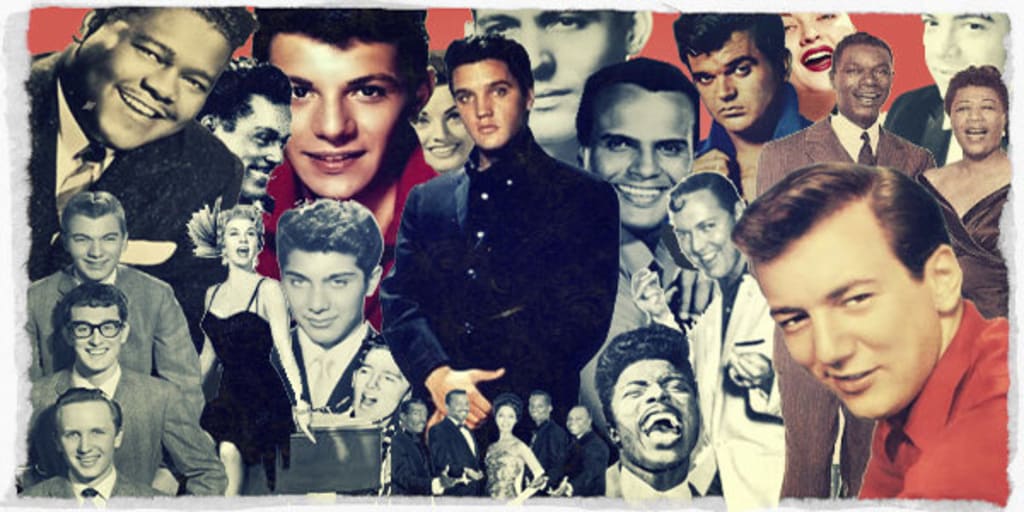
By the time the Beatles stepped onto the Ed Sullivan stage in February 1964, the world of music had already been shifting for over a decade.
The 1950s gave birth to rock and roll, a sound that blended rhythm and blues, country, gospel, and pop into something loud, thrilling, and, for the time, dangerously new. Elvis Presley, with his swiveling hips and deep southern drawl, wasn’t just a singer—he was a cultural eruption. Songs like Heartbreak Hotel and Hound Dog gave rock its edge and made teenagers feel like the music belonged to them for the first time.
Alongside Elvis came Chuck Berry, Little Richard, and Bo Diddley, whose guitar riffs and stage presence influenced generations. Buddy Holly stood out as one of the first rock musicians to write, perform, and produce his own music—a model that the Beatles would later follow closely. His sound was both innocent and smart, catchy but sincere. His sudden death in 1959 became a cultural wound—“the day the music died.”
At the same time, America was singing softer songs too. Doo-wop groups like The Platters and The Drifters offered rich harmonies and romance under streetlamps. Female vocalists like Connie Francis, Brenda Lee, and Lesley Gore added sweetness and sass, while behind the scenes, songwriters at Brill Building in New York were crafting hits for teen idols and girl groups. From this world came the Ronettes, the Shirelles, and the Chiffons—all paving the way for a more mature, emotional pop landscape.
Meanwhile in Britain, artists like Petula Clark were already performing and recording, long before most Americans knew her name. She had been a child star and charting singles in the UK well before Downtown made her a household name in the U.S. in 1965.
Peter and Gordon, too, would emerge just after the Beatles, but their sound—especially under the songwriting mentorship of Paul McCartney—reflected the tenderness and melodic instincts of earlier American pop traditions.
And then there were groups like The Vogues—polished, elegant harmonizers whose music blended doo-wop roots with orchestral arrangements and emotional sincerity. Though they gained national fame post-Beatles with songs like You’re the One and Five O’Clock World, they were singing together in Pittsburgh as early as 1960, quietly preparing their place in pop history.
So, while the Beatles’ arrival felt like a musical revolution, it didn’t appear out of nowhere. The groundwork had been laid—in jukeboxes and late-night radio shows, in church choirs and street corners, in AM signals and sock hops. The Beatles lit the match, but the fire had been waiting.
Author Profile